Sunday, March 21, 2010

Fantastique (A Game of Thrones)

In high school and college I read a little bit of science fiction (Arthur C. Clarke and Philip K. Dick), but even less fantasy. Several months ago I picked up a used copy of this Portable Professor course on fantasy literature. I like listening to talk radio more than music a lot of the time in the car, so this was a nice drive-time diversion for a couple of weeks. It's a good introduction to fantasy in general, but mostly Tolkien and afterwards.

Some time before listening to this I had picked up the first four volumes of A Song of Fire and Ice through bookmooch.com. After listening to the course I picked up the original Shannara trilogy. Most recently I picked up the first 10 books in the Wheel of Time epic by Robert Jordan in a cheap eBay lot.

Here's where fantasy becomes a problem for me. By law, fantasy novels have to be between 500 and 1,100 pages, and a minimum of 3 volumes. Okay, that's not remotely true, there are plenty of shorter and standalone works. However, it seems that most of the ones I'm interested in do fall into the epic fantasy category. Unfortunately, I'm much faster at buying books than I am at reading books, so buying 10 Robert Jordan books at once, for example, does nothing to ease that problem. With all this unread fantasy lying around, I decided I'd better get a move on and have been spending more time reading A Game of Thrones by George R. R. Martin. As it happens, HBO recently green-lit a series based on the book, the pilot for which was previously filmed.


A Game of Thrones is the first of seven projected novels in the Song of Fire and Ice series. After 14 years, only four volumes are published, but number five should be imminent. In the land where the series is set, seasons last years, and summer has lasted a decade, but winter is coming, and long summers mean long winters. The Seven Kingdoms of Westeros may not be so different from medieval England. There are castles and kings, horses and knights, but there are no wizards or magic...only ice zombies (my description, not the author's).


The novel starts with a vignette north of The Wall in the Haunted Forest. The only people who live north of the wall are Wildlings and The Others (or ice zombies, believed to be old fairy tales). It then stays away from anything supernatural for the next 500 pages. The reader is introduced to Eddard "Ned" Stark, Lord of Winterfell, and his family. Stark is offered the position of "Hand of the King" after the previous Hand (his wife's brother-in-law) dies, but he is reluctant to accept and move south, away from his ancestral lands. Reluctant, that is, until his wife receives a secret note from her sister claiming that the Hand was killed by the Queen's family, the Lannisters.

It's not long after this that something happens to Stark's second-oldest true-born son (he has a bastard son and a son with his wife who are about the same age). From this point onwards in the novel, things go pretty much downhill for the Stark family. I'd hate to give too much away, but this is a novel of deceit, greed, double-dealing, secrets, murder, and politics. As secrets are revealed and the politics play themselves out, the protagonists find themselves in positions from which recovery seems more and more impossible. The reader wonders how characters can possibly get out of their respective situations as things continue to escalate, not unlike watching a LOST season finale (see Season 4), or the dark cliffhanger of The Empire Strikes Back. By the time the reader realizes that the book is running out of pages to get characters out of their respective dilemmas, and assumes the author is setting up a cliffhanger situation, it unexpectedly gets even worse. Maybe we should be taking the author more seriously when one character says, "There are no heroes." What kind of ending is this pointing to six books later?

There are two interesting aspects to the storytelling that make this book different from what you might expect in epic fantasy. The first is quickly obvious to the new reader. Each chapter is devoted to a specific character and simply titled with that character's first name. Early on, most of the characters are in the same place, so the overlap of characters in the chapters of others is significant. The overall story as well as the story of each character progresses in each chapter. (Again, this structure is very similar to LOST.) Usually by the time we get back to that character again, time has passed and the action between chapters is inferred or described through dialogue. The structure works great overall, but can be a distraction as we get invested on one story only to then jump to one that is almost wholly (so far) unrelated.

The other element of the novel that stands out is that it is surprisingly personal and intimate. It's a little like watching television through binoculars (or the movie Signs: an alien invasion of the entire planet related only through the experiences of 4 people who never leave their farm).. You're not going to get the whole story from what you can see, and it's clear that there's a lot going on off-stage, but you only get that information as other characters discover it second hand. Battles are heard through windows or from a safe distance away in the woods, unlike the intensely detailed descriptions of Tolkien, but the multiple cliffhangers by the time page 800 rolls around are not at all unlike Fellowship or Two Towers.

A Game of Thrones was clearly never intended to be a standalone read as there are no resolved story lines, but only actions that up the ante for the future. Although it's not resolution, the final chapter ends on a strong, if unsurprising note, followed only by a helpful appendix to keep most of the characters straight in the reader's mind, although it's easier, now, to just use the wiki site.

No Trespassing


I think I'm going to need to go back when the Holga comes in.

Wednesday, March 17, 2010

Fog-graphy

Last Friday when I woke up there was an incredible amount of fog. I took this picture in B&W on my "new" point and shoot Canon Powershot SD780 IS Digital ELPH. I added a minimal amount of color and increased the contrast in GIMP.


My Fuji Z1 had been having some issues and wasn't really working right, even with a new battery, and I wanted a camera that would fit in my pocket. I picked this one because it also shoots video in HD at 720 x 1280 pixels, and numerous other features.


Speaking of photography, today I ordered a Holga 120N and a box of black and white Kodak T400 film, hopefully in time to take it with me to Virginia at Easter. This is essentially a $28 plastic "toy" with a simple plastic lens with back covers that tend to leak light in on the film unless electrical tape is used. However, it uses medium format film (read: higher resolution than 35mm) and can lead to interesting and sometimes unexpected results. It can be adapted for 35mm film, though, which allows you to use the entire film, capturing your image from edge to edge, even between the sprocket holes. I first heard of this type of camera on the LOST Season 1 DVD set that included photos taken by Matthew Fox on his Holga during filming, and collected as a gift book given to the cast. The shutter is uncoupled from the film advance, so double exposures are easy. One of the best shots I saw used a shutter release cable to lock open the shutter during a storm until lightning struck. People will often put a color filter in front of the lens, even with color film, cross-processing, intentional under- or over-exposures, and general experimentation.


This link has some example of the possibilities inherent in a toy plastic camera.

Sunday, March 14, 2010

KFC Butter and Honey

I noticed something while eating biscuits at KFC, and I have no idea how long this has been the case. KFC no longer provides honey and butter for their biscuits. If you ask for honey and butter you actually get Honey Sauce and Buttery Spread.


If we look a little closer at the packages, we find that the Honey Sauce is mostly inexpensive corn syrup and contains a whole 11% honey.


At least they actually give the ingredients for the honey. For the Buttery Spread, all we know is that it's Artificially flavored. If it's flavored to taste like butter, and they apparently can't legally call it butter, it's a safe bet it's not butter, so where are the ingredients?


Tuesday, March 2, 2010

Girl in Landscape by Jonathan Lethem

I first became aware of Jonathan Lethem a couple of years back when he was listed as the editor of Four Novels from the 1960's by Philip K. Dick, released by Library of America. Others may recognize the name as the author of Fortress of Solitude. As someone who has read less than half the books I own (I'm better at buying or trading than reading), the last thing I need is interest in another author. However, I recently read an couple of articles about Lethem written at the release of his latest book, Chronic City (I believe both articles came from Google Alerts about Raymond Chandler). In one of the articles, What writers risk in not repeating themselves, the author wrote, "Jonathan Lethem's output is impressively diverse, but it's not going to win him a dedicated readership."

The article that really piqued my interest though, was part of the book review found on the same site:

Many of Jonathan Lethem's novels have looked like experiments in creating striking generic hybrids: Gun, With Occasional Music is a pastiche of Raymond Chandler set in a dystopian future; Girl in Landscape a western set in space; As She Climbed Across the Table a tragicomic campus novel with a science fiction twist. Lethem has always rejected the "genre bender" label, however, and perhaps trying to fit his books into too many categories is simply a way of admitting that they defy categorisation.

Yes, that's categorisation with an "S". It's a British website.

Though it frequently doesn't work well, I do enjoy seeing more than one style or genre together in the same story. It's certainly part of the charm of the space western Firefly, and though I haven't read the comic, I'm looking forward to the movie adaptation of Cowboys and Aliens.

After reading these articles, I decided I wanted to check out a couple of his books, but the library did not have Gun, With Occasional Music in the system. When I checked Half Price Books, I was glad to find that title, Girl in Landscape, and a collection of short stories (The Wall of the Sky, The Wall of the Eye), in new condition for just $4 each.

I finished reading Girl in Landscape, and it is fairly difficult to describe. A family moves from Earth to another planet that used to be a thriving alien civilization, but now lies in ruins. The book has been compared to The Searchers, but there's almost no resemblance in plot, only in setting. The planet is quite barren and the family settles in a very small community of less than 20 people and a couple of remaining aliens. Ultimately, the plot is fairly basic and not that important to the reader, only to the characters themselves. I came away from the book feeling like I'd witnessed the author conducting an experiment. Some sections of the book are hypnotic (there are some similarities to Avatar, which came later), but what the reader ultimately leaves with is the fairly tragic portrait of several teen-and-younger children who have to grow up too quickly in a place where they couldn't be more alone.

Monday, February 22, 2010

We Are The Fallen

I never really cared for or about American Idol except to watch the people who can't sing early in each season. However, a couple of years ago, I couldn't help but pay attention to Carly Smithson, the tattooed songstress with an Irish accent. It's probably best that she finished 6th instead of winning, otherwise the show probably would have tried to mold her into a pop singer, which didn't result in commercial success for her the first time they tried it (at right). I've been watching since the season ended to see what she might end up doing. Apparently she was working on an album when she hooked up with John LeCompt and Ben Moody, both formerly of Evanescence (it's reported that her solo album hasn't been abandoned).


To give some background, I first heard of Evanescence in 1998 when I bought a sampler CD at Cornerstone Music Festival. They had the best song on the CD, an epic goth number called Understanding. At this time, the band was still only Amy Lee and Ben Moody. I wrote to the company that put out the compilation, Brad Caviness' BigWig Enterprises, to find if they had any albums out. It turns out that they didn't yet, but that fall they released what is now the infamous Evanescence EP.


If you do an internet search on this title, you will find that there were only 100 official copies, and a claim that they were all sold in one night at a show in Little Rock. I know they couldn't have sold more than 99 copies that night because I was able to mail order one from Brad Caviness. In 2003, when Bring Me To Life was released as a single from the Daredevil Soundtrack, people were desperate to hear move Evanescence and I sold my copy of this CD for more than $350 on eBay (after ripping the WAV files of course). The value of this disc resulted in a lot of fake copies finding their way onto eBay as well.


David Hodges joined Ben and Amy in 1999 and they released Origin in 2000. This album ends up basically as a demo for Fallen, but by the time that album was released, David Hodges had moved on and John LeCompt had joined the group on guitar and Rocky Gray (Living Sacrifice) on drums. As it stands now, Evanescence has no original members with the exception of Amy Lee on lead vocals.


Comparisons are inevitable, then, now that Ben Moody, John LeCompt, Rocky Gray, and Marty O'Brien on bass (Disturbed), have started We Are the Fallen with Carly Smithson. Evanescence fans are already on the attack, complaining that WATF is an Evanescence wannabe. Similarities in sound are unavoidable. WATF (it strikes me this isn't the best abbreviation for the group's name) has more Evanescence members than Evanescence does (unless you go back to the ORIGINAL original lineup, in which case it's 50/50). For my part, I'm just happy to see Carly Smithson with a musical outlet far from American Idol, although without that show, we might not have the good fortune of hearing her. The more rock bands with strong female lead vocals, the better.


Sunday, February 21, 2010

In defense of Shutter Island

I'm not a huge "scary movie" / horror fan, and I usually prefer films that stay away from the supernatural realm. So, going into Shutter Island I was only cautiously optimistic since it was a Martin Scorsese movie, and he had been heartily endorsed by LOST co-creator Damon Lindelof.

SPOILERS WITHIN

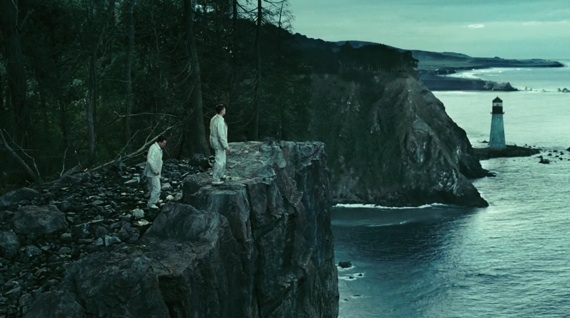
Shutter Island is a movie of deception, misdirection, and outright subterfuge. The deception starts with the movie trailer. This is not a horror film. It's not a scary film. Occasionally a little gruesome and disturbing, yes, but not scary. There is also nothing supernatural going on in the film. Scenes that appear supernatural happen only in Teddy's dreams. The opening shots of the film are overlayed by music that sounds like it's taken directly from The Shining. The audience is led to believe they're watching something scary as a ferry cuts its way through dense fog. Throughout the film, whenever this "scary" music occurs (including some prepared piano), it builds only to come to an abrupt conclusion and reveal something mundane. The lone "cause the audience to jump" moment comes from an unexpected gunshot blast out of frame at loud volume. The soundtrack will often pay homage to Psycho's strings-only sound, although the director mentions only Vertigo and Spellbound as influences.


It's not until late in the film that the viewer realizes Scorsese is presenting a situation where the realities of both the audience and DiCaprio's Teddy Daniels are subverted. Before I go any further, I need to reveal the twist, so this will be where the spoilers really start. Teddy thinks he's attempting to uncover a conspiracy on the island and that anyone who gets too close to declared insane and kept there. Reality as it's presented in not an effort to convince Teddy he's crazy and keep him there. He really does live in his own created reality where he's still a Federal Marshall attempting to solve the escape of a patient from a locked room. The doctors have decided to let him play out his fantasy to its conclusion in hopes that when he finds nothing treacherous happening on the island he will snap out of his fantasy. Teddy starts seeing things while awake that don't make sense as he withdraws from his medication. I know, it sounds like a cliché. In fact it is, but the reason it works in this film is, since it is a cliché, everyone stays away from that story in favor of conspiracies in order to attempt not being predictable (Flight Plan?). So it seems to me that this type of story has come full circle. It was done so much in the past, abandoned and is now no longer expected. The few people who said they guessed the ending in the first ten minutes are not being honest. Yes, that thought it going to cross the mind of any experienced filmgoer, but surely Scorsese isn't going to go that route, right?! THAT's why it works in this case. I was so convinced it wouldn't end that way, then even in the seconds before the credits rolled, I was still waiting for the second twist showing that it really was a conspiracy designed to keep this Marshall from discovering the truth about the island. As it turns out, Teddy's only enemy is himself and we're made to experience Teddy's devastation in accepting his own life, while we're still in denial that he's a patient in the hospital.

The greatest achievement of the film is that it keeps your mind circling for hours after it ends. Of the things we saw on the screen, how much was real, and how much was created by Teddy (real name Andrew Laeddis)? His mind is unable to deal with the fact that he killed his wife after she killed their three children. Some entire characters are in his head, the "escaped patient" is a nurse, and his new partner is actually his doctor while he projects details of his own life onto others (whether they exist or not).

The Vertigo influence is obvious as Teddy climbs the spiral staircase of a lighthouse towards the climax of the film, once and for all to find no nefarious goings-on, only his own case history. In Vertigo, two people stage a false reality to convince Scotty of something that isn't true. In Shutter Island, a hundred people allow Teddy to stage his own false reality to try to convince him of what is true.

It remains to be seen what the rewatchability of this film will be. It's unfortunate that it's already suffering a backlash and being called Scorsese's worst film (by a few bloggers, not everyone...I think the B average is fair). In a lot of ways, (all due credit to Dennis Lahane, whose book I haven't yet read) it's as if Scorsese has remade a 1950's B-movie. While it may not win any awards, I can't see much of an argument that Shutter Island isn't an entertaining, engaging, technical achievement of a period piece. It deserves to be appreciated for what it is (thoroughly Scorsese, including his quick curved track shot around a character), and not for what people wanted it to be.